Disclaimer: This article is for educational purposes only. The drugs mentioned are not promoted; some require a prescription from a qualified physician and should be used under medical guidance.
Wegovy
What if a drug could help you lose 15% of your body weight without exercise or dieting, with no side effects, and even improve cardiovascular health and prevent dementia? Would you buy it?
Historically, weight-loss drugs have been dismissed as hype or a tax on the gullible. So why is this one drawing so much market attention? And what has driven the company behind it to surpass LVMH as Europe's new stock king?
Our protagonist: Novo Nordisk, a Danish company
How many obese people will there be in the future?
To understand the future weight-loss market, we first need to know how many people will be overweight or obese.
(Source: World Obesity Atlas 2023)
Estimates of global overweight and obesity levels (BMI ≥ 25 kg/m²), referred to as high BMI in the atlas, suggest that by 2035, over 4 billion people may be affected, up from over 2.6 billion in 2020. This reflects an increase from 38% of the world's population in 2020 to over 50% by 2035 (excluding children under 5). Over the same period, obesity alone (BMI ≥ 30 kg/m²) is projected to rise from 14% to 24% of the total population, affecting nearly 2 billion adults, children, and adolescents by 2035. The highest rates of increase are expected among children and adolescents, with obesity prevalence among boys rising from 10% to 20% and among girls from 8% to 18% between 2020 and 2035.
Table 1.1: Global overweight and obesity, 2020-2035
The proportion of overweight and obese people will rise from 38% in 2020 to 51% in 2035.
Table 1.2: Global obesity trends by sex for children, adolescents, and adults, 2020-2035
Adult male obesity rates will increase from 14% in 2020 to 23% in 2035; adult female rates from 18% to 27%.
China's adult obesity forecast
By 2035, China's adult obesity rate is projected to reach 18%, with an annual growth rate of 5.4% from 2020-2035. Childhood obesity will grow at 6.6% annually. By 2035, costs related to overweight/obesity management are expected to reach 3.1% of GDP.
Obesity trends by region
The atlas predicts rising obesity rates in low-income countries. By 2035, Kiribati, one of the least developed countries, is expected to have the highest adult obesity rate at 67%. Children and adolescents in low-income countries face the highest risk. Obesity rates among girls in low-income countries are projected to rise from 4% in 2020 to 13% in 2035; for boys, from 2% to 6%. Among adults, male obesity will increase from 5% to 11%, and female from 14% to 26%.
Novo Nordisk rides the wave
Revenue
FY2022
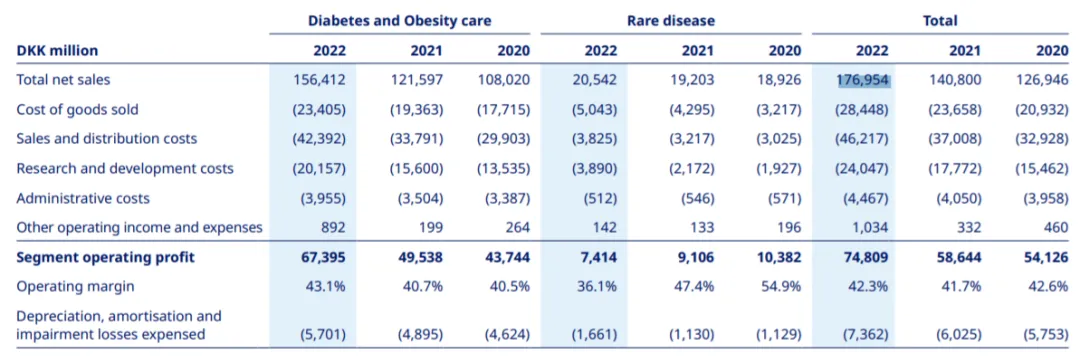
Novo Nordisk's 2022 annual report showed total sales of DKK 176.954 billion (USD 24.994 billion, at the reported exchange rate), up 26% YoY. Operating profit was DKK 74.809 billion (USD 10.566 billion), up 28%. Net profit was DKK 55.525 billion (USD 7.843 billion), up 16%.
Novo Nordisk is highly efficient and profitable. With total sales of DKK 176.954 billion, cost of goods sold was only DKK 28.448 billion, yielding a gross margin of 84%. Selling expenses were DKK 46.217 billion (26.2% of sales), R&D spending was DKK 24.047 billion (13.5% of sales), and administrative expenses were DKK 4.467 billion (2.5% of sales). Operating profit was DKK 78.409 billion, a margin of 42%.
Novo Nordisk started with insulin and still holds about 45% market share despite competitors. Sales of its long-acting, premixed, rapid-acting, and human insulins have all declined. In 2022, global sales were DKK 16.741 billion (USD 2.365 billion), DKK 10.562 billion (USD 1.492 billion), DKK 17.463 billion (USD 2.467 billion), and DKK 8.186 billion (USD 1.156 billion), respectively.
GLP-1 analogs are a newer class. Since liraglutide launched, Novo Nordisk has dominated this market. In 2022, total GLP-1 sales reached DKK 100.235 billion (USD 14.157 billion), with semaglutide alone at USD 10.882 billion, the star product. Beyond diabetes, Novo Nordisk has a strong coagulation factor pipeline (factors VII, VIII, IX), with 2022 global sales of DKK 8.308 billion, 2.338 billion, and 759 million, respectively, growing 14.6% to DKK 11.709 billion. Rare endocrine hormones (e.g., growth hormone) are smaller, with 2022 sales of DKK 7.138 billion, down YoY.
Notably, Novo Nordisk disclosed China sales: semaglutide injection, liraglutide injection, and semaglutide tablets brought in DKK 2.179 billion, 1.478 billion, and 63 million, respectively. Semaglutide saw explosive growth in China. Total insulin sales in China were DKK 10.302 billion, down 16.2%, likely due to volume-based procurement. Liraglutide for weight loss had only DKK 133 million in China sales; the market hasn't fully opened, and semaglutide for weight loss is not yet approved in China. Coagulation factors and rare endocrine hormones in China were DKK 604 million and 246 million, respectively, both growing strongly. Despite insulin procurement, Novo Nordisk's China sales rose 2% to DKK 16.209 billion (RMB 15.437 billion).
H1 2023
First-half 2023 total revenue was DKK 107.667 billion (USD 15.961 billion, at average 2022 rate of 1 DKK = 0.14824 USD), up 29% YoY. Operating profit rose 30% to DKK 48.895 billion (USD 6.927 billion). China revenue was DKK 8.928 billion (USD 1.323 billion, +6%), 8% of total. Ozempic China sales were DKK 2.213 billion (USD 328 million), already exceeding full-year 2022.
The strong performance was driven by diabetes and obesity segments. Combined H1 2023 sales grew 36% to DKK 98.977 billion (USD 14.672 billion). Diabetes segment sales were DKK 80.829 billion, up 23%; obesity segment sales were DKK 18.148 billion, up 158%. Semaglutide products (Ozempic, Rybelsus, Wegovy) totaled DKK 62.166 billion (USD 9.215 billion), up 87%, accounting for 57.74% of total revenue.
Diabetes remains Novo Nordisk's core. GLP-1 sales in H1 2023 were DKK 54.736 billion, up 49%. The obesity segment has become a new growth driver, with Wegovy and Saxenda totaling DKK 18.148 billion (+158%).
Earnings expectations
(Source: Morgan Stanley Research Estimates)
Morgan Stanley research shows that with rapid expansion of obesity drug reimbursement, 40 million Americans (out of ~110 million obese adults) can access these drugs through insurance, exceeding the 37 million Americans with diabetes. Analysts estimate obesity drug sales for diabetes treatment could exceed USD 56 billion by 2030, up from a prior estimate of USD 40 billion.
Mechanism of action and similar drugs
Wegovy / Semaglutide
WEGOVY (semaglutide) injection 2.4 mg is a prescription injectable that helps obese adults and children aged ≥12 (BMI ≥30, or ≥95th percentile for age/sex) or overweight adults (BMI ≥27) with weight-related medical problems to lose weight and keep it off. It should be used with a reduced-calorie meal plan and increased physical activity.
Note: Wegovy and Ozempic both contain semaglutide but are not interchangeable. "Each medication has a unique safety and efficacy profile which is detailed in its respective product label. The products are not interchangeable."
Metformin
Metformin (C4H11N5), common brands Glucophage, is a first-line drug for type 2 diabetes, especially in overweight patients. It is also used for polycystic ovary syndrome, and some studies suggest it may prevent cardiovascular disease and cancer complications. It is oral and does not cause weight gain.
Metformin typically has no significant side effects. Common ones include diarrhea, nausea, and abdominal pain. Hypoglycemia is rare. However, improper use can lead to lactic acidosis, which can be fatal. It is contraindicated in liver disease and renal failure. No known harm during pregnancy, but insulin is generally recommended for gestational diabetes. It is a biguanide that works by reducing hepatic gluconeogenesis and increasing insulin sensitivity.
Metformin was first discovered in 1922, but clinical research began in the 1950s by French physician Jean Sterne. It was approved in France in 1957 and in the US in 1995. It is on the WHO Model List of Essential Medicines.
In 2019, Cancer Cell published a study showing that metformin under fasting conditions significantly inhibited tumor growth, suggesting the PP2A-GSK3β-MCL-1 pathway as a potential target.
Pharmacology:
(Sources: Baidu Baike, Wikipedia)
Other combination drugs: Rosuvastatin
A selective HMG-CoA reductase inhibitor. It increases hepatic LDL receptor numbers, promoting LDL uptake and catabolism, and inhibits VLDL synthesis, reducing total VLDL and LDL particles.
Brand name Crestor, a statin used with exercise, diet, and weight loss to treat hypercholesterolemia and prevent cardiovascular disease. Developed by Shionogi.
(Sources: Baidu Baike)
Other drugs like empagliflozin and ezetimibe exist; interested readers can explore further.
Impact on other industries
Bariatric surgery
Bariatric surgery helps when diet and exercise fail. Intuitive Surgical (ISRG.US) noted that patient interest in weight-loss drugs has affected surgery demand. Teleflex (TFX.US), which makes Titan gastric staplers, reported declining demand due to GLP-1 treatments. Medtronic (MDT.US) also noted a "small impact" on bariatric surgery, which is a minor part of its business. Conmed Corp. estimates about 2% of its instruments are used in bariatric procedures.
Deutsche Bank expects bariatric surgeries to decline 5% annually.
Fitness
Morgan Stanley: After starting Wegovy, the proportion subscribing to fitness/weight-loss plans dropped from 29% to 20%, and diet product purchases fell by one-third.
Food retail
Weight-loss drugs also change eating habits. A Morgan Stanley survey found that patients eat fewer meals and snacks, and consume less alcohol and sugary drinks. Most participants visited fast-food and pizza places less often after starting the drug. Pictet Asset Management notes a growing industry developing alternative ingredients to reduce sugar demand and stabilize insulin levels. They highlight Danish enzyme maker Novozymes, which developed an enzyme that naturally sweetens dairy products.
Is it still investable?
Competition
GLP-1 human protein was discovered by Eli Lilly, not Novo Nordisk. Other pharma companies like Amgen, AstraZeneca, and Pfizer are entering the space, and Indian generic manufacturers could compress Novo Nordisk's margins.
Affordability
Wegovy costs about RMB 1,000 per unit on Chinese platforms. In the US, a month's supply is around USD 1,300. Morgan Stanley estimates that by 2030, 24 million Americans will use Wegovy, with prices potentially falling to USD 200/month, generating USD 560/year in revenue.
Production issues and potential regulatory risks
In summary, weight loss is poised to become a massive market. Whether or not you invest in Novo Nordisk, this represents a significant opportunity that will change our lives in some ways.
Risk disclaimer: This content is for informational purposes only and does not constitute investment advice. Past performance does not guarantee future results. Market risk exists; invest with caution.

专注投资分析、市场洞察与资产配置。不追短期波动,只理解真正驱动长期回报的东西。