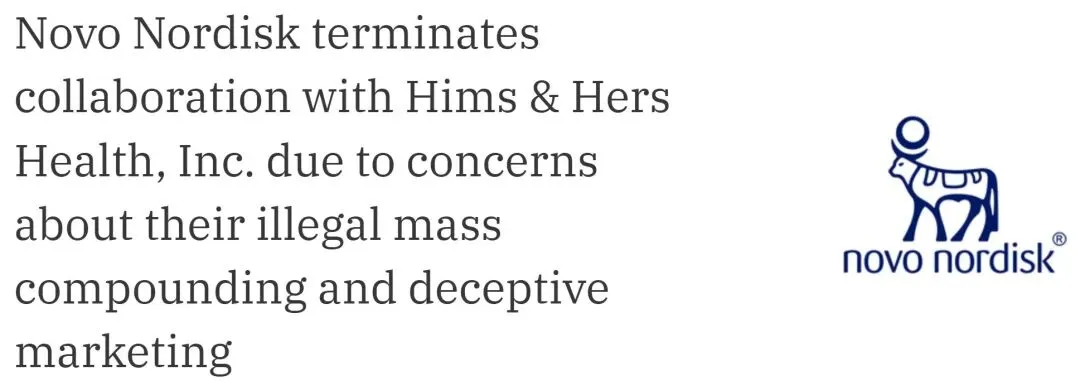
On the 23rd, Novo Nordisk terminated its partnership with Hims & Hers Health, citing "deceptive marketing" practices.
Novo Nordisk's move came less than two months after the two companies announced a "long-term partnership" to improve access to obesity treatments.
Following the announcement, Hims & Hers shares plunged more than $20, or about 31%, to $44.10.
The company had expected weight-loss service revenue to exceed $700 million this year, but that target may be hard to hit without Wegovy sales. HIMS CEO Andrew Dudum posted on X that Novo Nordisk tried to control HIMS's clinical standards, forcing them to steer patients toward Wegovy regardless of what was clinically best for the patient:
If you don't know what Novo Nordisk and Wegovy are, refer to the previous article The New European "Stock King" Surpassing LVMH! How Big Is the Weight-Loss Drug Market?, where we detailed Novo Nordisk and its flagship product Wegovy.
In our earlier analysis of Hims & Hers Health's earnings US Star Stock Earnings Analysis | HIMS: Strong Growth and Potential Impact of Trump's Drug Pricing Policy, we noted that HIMS sells not only Novo Nordisk's branded drugs but also other weight-loss related products, including customized compounded drugs:
To understand this event, we first need to distinguish between branded patented drugs and compounded drugs:
- Branded patented drugs like Wegovy are developed and patented by pharmaceutical companies, sold at high prices, and only the patent holder can produce and sell them.
- Compounded drugs are customized by pharmacists to meet specific patient needs, typically cheaper, but must comply with strict regulations.
HIMS sells compounded semaglutide through its telehealth platform at prices far below Wegovy, accounting for 15% of its 2024 revenue (Yahoo Finance). Novo Nordisk argues this violates FDA rules that compounded drugs should only be used for individualized patient needs.
In 2023, due to shortages of some Wegovy doses, the FDA temporarily allowed compounded semaglutide sales to meet demand. However, on May 22, 2025, the FDA declared the shortage resolved, subjecting compounded drugs to stricter scrutiny.
FDA regulation is based on the following laws and provisions:
Section 503A of the Federal Food, Drug, and Cosmetic Act (FD&C Act):
- Requires compounded drugs to be customized for specific patients, produced by a licensed pharmacist or physician based on an individual prescription.
- Prohibits pharmacies from "regularly or inordinate amounts" producing compounded drugs that are essentially copies of FDA-approved marketed drugs (like Wegovy), to prevent commercial-scale production.
In the Novo Nordisk vs. HIMS dispute, Novo Nordisk accuses HIMS of mass-producing compounded semaglutide, violating Section 503A restrictions.
Source:
https://www.fda.gov/drugs/human-drug-compounding/section-503a-federal-food-drug-and-cosmetic-act
Section 503B of the FD&C Act:
- Applies to FDA-registered outsourcing facilities, allowing compounded drug production but requiring compliance with current good manufacturing practices (CGMP).
- Outsourcing facilities must report adverse events to the FDA and undergo regular inspections.
If HIMS's compounded drugs are produced by an outsourcing facility, the FDA may review compliance with CGMP standards.
Source:
https://www.fda.gov/media/97359/download
So we can see that HIMS's practices do not violate FDA rules. What may have angered Novo Nordisk is that while HIMS sells branded patented drugs, it also offers its platform's compounded drugs to consumers. The cooperation agreement between Novo Nordisk and HIMS did not explicitly prohibit HIMS from selling similar weight-loss drugs (compounded GLP-1s) after the partnership. Impact on HIMS: When HIMS announced the partnership with NVO, its stock rose over 20% that day, indicating the partnership's importance to HIMS's performance. In the short term, HIMS will indeed be affected by the weight-loss drug business. But in the long term, HIMS is exploring new businesses in menopause and testosterone, which are closely related to its existing treatment areas: weight loss, mental health, Hers skincare, Hims skincare, and sexual health. These two areas may hold significant potential: the menopause treatment market is expected to grow at a CAGR of 4.8%, and the testosterone market at a CAGR of 4%. So for HIMS, if it can continue to attract more platform users and maintain high repurchase rates and high average selling prices, its performance will still have strong support.
Risk Warning: This content is for reference only and does not represent any investment advice. The market carries risks; invest with caution.


专注投资分析、市场洞察与资产配置。不追短期波动,只理解真正驱动长期回报的东西。