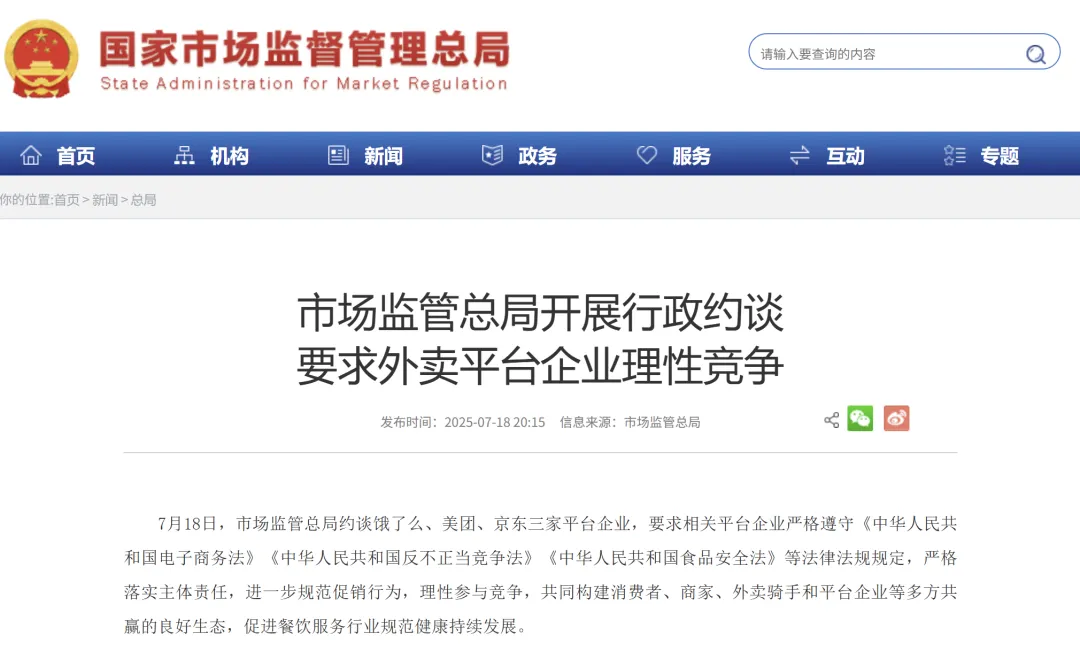
On July 18, China's State Administration for Market Regulation summoned three food delivery platforms to further regulate promotional practices, jointly build industry norms, and promote healthy sustainable development. The move aims to curb disorderly competition driven by massive subsidies (e.g., RMB 25 billion spent by JD.com, Alibaba, and Meituan in Q2 2025), which had harmed rider rights and worsened the market ecology.
Looking at the Hang Seng Tech Index constituents, Ele.me (Alibaba), Meituan, and JD.com are all top ten holdings, together accounting for about 20% of the index. While not insignificant, calling the index the "Hang Seng Delivery Index" would be inappropriate.
By sector, non-essential consumption and information technology companies dominate the index.
From a valuation perspective, the Hang Seng Tech Index's overall P/E is around 20x, at the 11.91% percentile historically, lower than the 24-28x P/E seen at the start of the year, indicating improved profitability of constituent stocks. Overall ROE has also risen from 12% to about 14%. The price-to-book ratio (P/B) is 0.98x, dividend yield is low, but ROE is expected to improve to over 15% in 2025, driven by AI and e-commerce recovery.
We also observe that the Hong Kong interbank offered rate (HIBOR) has steadily risen from near 0% in early July. In a previous article HKD Exchange Rate Rarely Volatile: Why from Strong Side to Weak Side?, it was mentioned:
If risk appetite rises, attracting HKD funds into the stock market, the current declining turnover needs to be reversed.
Huang Mingtao, Public Account: Mingtao HUANG HKD Exchange Rate Rarely Volatile: Why from Strong Side to Weak Side?
HKD market liquidity is ample, coupled with year-end rate cut expectations, Hong Kong stocks stand to benefit from risk-on flows.
HIBOR reflects HKD liquidity conditions. As of July 16, 2025, overnight HIBOR was 0.12%, 1-month 1.17%, and 3-month 2.01%, all at historical lows. This is thanks to the HKMA injecting liquidity via forex intervention, with the banking system balance surging from HKD 44 billion to HKD 174 billion. Low HIBOR reduces borrowing costs, stimulating stock market investment, especially for high-growth tech stocks.
Ample HKD liquidity (near-zero overnight rate) drives funds into equities, benefiting the Hang Seng Tech Index in H1 2025. However, if Fed rate cut expectations disappoint or US-China trade tensions escalate, HIBOR could rebound, increasing volatility. But the current environment resembles the low-rate cycle of 2023, supporting the index to rise above 5,500.
From a technical perspective, the long-term trading range of Hong Kong stocks is gradually shifting higher.
The DeepSeek moment earlier this year provided a new engine for Hong Kong stock investment. On the day Nvidia's H20 chip ban was lifted, Hong Kong stocks also saw a notable rally. If the narrative shifts from "anti-internal competition" to tech innovation, improved corporate earnings efficiency could further fuel the investment thesis.
Over the past five days, there have been multiple instances of opening high, pulling back, then V-shaped recoveries, indicating fierce battles between bulls and bears near the upper edge of the consolidation range. The key driver to break the balance may be volume. If volume expands significantly on a breakout above the range, bulls dominate. Conversely, if pullbacks are on shrinking volume, it suggests bulls are holding, signaling further upside. A healthy breakout could see the Hang Seng Tech Index return to around 6,000.
In summary, the Hang Seng Tech Index is attractive on stable regulation, low liquidity costs, foreign inflows, and bullish technicals. Reasonable valuations and earnings recovery provide fundamental support, but risks of a pullback to the range remain. However, with external headwinds like US-China trade deals and Fed rate cuts easing, the medium-to-long-term upward trend should remain intact.
Risk Disclosure: This content is for reference only and does not represent investment advice. Markets are risky; invest with caution.
Interested? Follow for more updates.


专注投资分析、市场洞察与资产配置。不追短期波动,只理解真正驱动长期回报的东西。