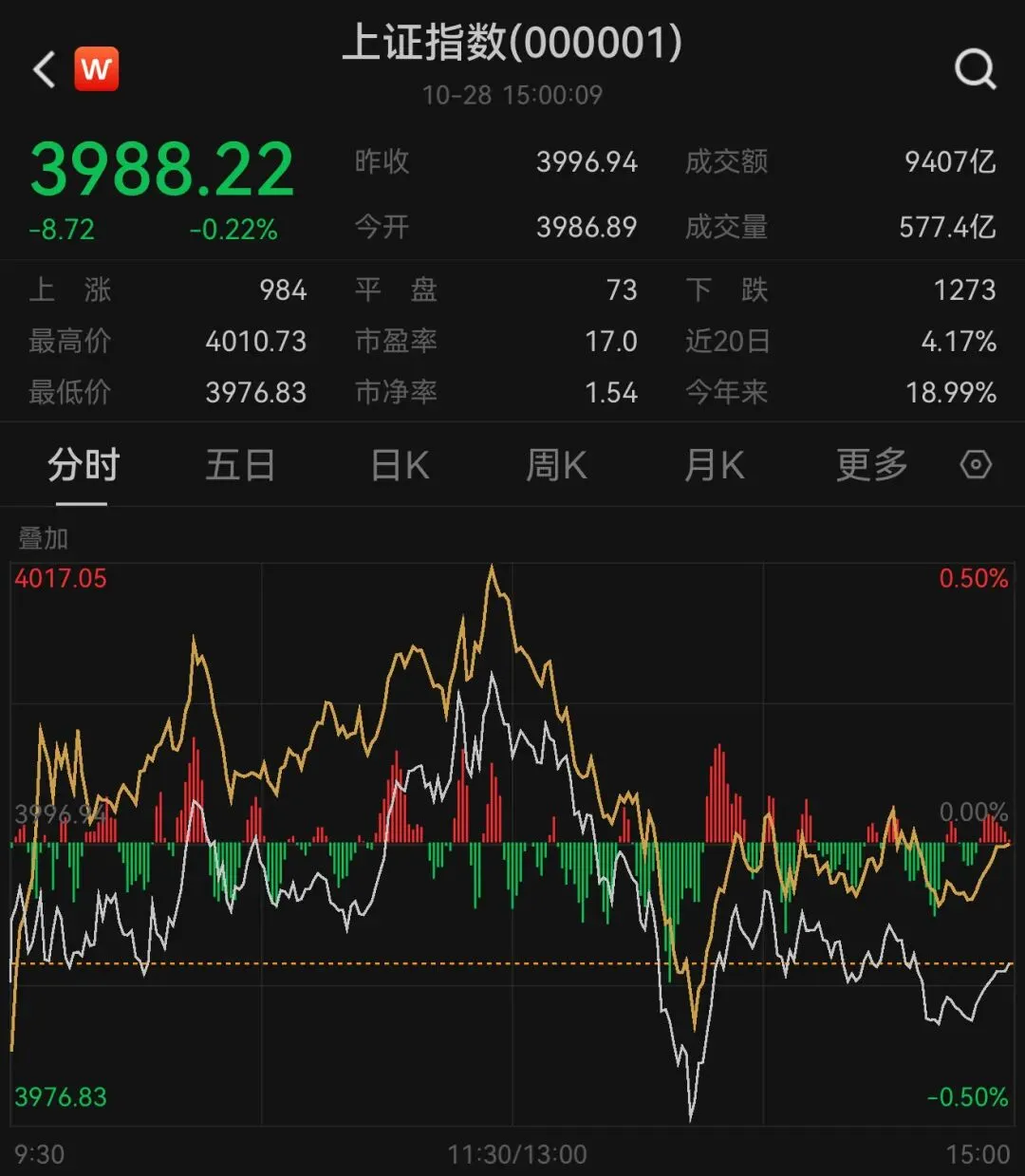
Today (Oct 28), the A-share market opened lower but rallied, with the Shanghai Composite briefly breaching 4,000 points by around 10:15 AM. This marks the first time in 3,723 days—since August 18, 2015—that the index has reclaimed this key historical level.
The Shanghai Composite is up over 19% year-to-date, with a notable 21%+ gain in the last six months.
Why does 4,000 matter so much? It's not just a number—it's a powerful psychological symbol. First, the round-number and anchoring effects: 4,000 is highly recognizable, becoming a reference point for market decisions. Profit-takers see it as a take-profit warning, while sidelined cash views it as a breakout confirmation. This collective focus amplifies the battle at this level, turning it from a mere point into a symbolic gauge of market strength. As the saying goes, once above 4,000, media headlines shift from "market rebound" to "bull market confirmed." But unlike the frenzied, retail-driven 4,000 points of the past, this time is quieter. The climb has been longer and weaker, partly because investors have learned their lesson—no more all-in margin buying—and partly because the market is much larger. With over 5,000 listed companies (vs. 2,000+ in 2015) and daily turnover exceeding 2 trillion yuan, the market can't support rapid, massive gains. Second, cross-cycle scarcity: The last time the A-share firmly held above 4,000 was 2015. For investors who entered in the past decade, this is a rare, cross-cycle level they've never experienced. In the 35-year history of the A-share market, it has spent only about 3% of the time above 4,000. This long absence elevates 4,000 beyond an index level into an emotional vessel for witnessing history, carrying hopes for a bull market and an end to long-term volatility.
Internal market drivers: Who's leading? According to Wind data, this rally is led by information technology and high-end manufacturing. Sector-wise, since the start of 2025, communications is up 28.19%, electronics +27.64%, and defense & semiconductors both over 21%. Margin trading (margin + securities lending) has surged to over 2.48 trillion yuan, reflecting heightened activity.
Macro backdrop and outlook: The rally is supported by ample liquidity, improving fundamentals, and a better external environment. In September, industrial profits grew 21.6% YoY, accelerating from 20.4% in August. Aerospace, smart consumer equipment, and other new-quality productive forces saw particularly strong profit growth. The operating profit margin rose for a second consecutive month, confirming that anti-internal-competition policies are curbing price wars and boosting earnings quality. Externally, China and the US have reached a basic consensus on resolving respective concerns, with People's Daily's Zhong Sheng column noting that "the consultation results are hard-won and need joint maintenance."
Institutional views: Central China Securities sees a slow bull market continuing, supported by the Fourth Plenum's 15th Five-Year Plan基调, the Fed's rate-cutting cycle, and easing US-China trade tensions. China Merchants Securities expects Q3 non-financial A-share earnings to improve marginally, highlighting IT (communication equipment, semiconductors) and recovering mid-to-high-end manufacturing (auto parts, photovoltaic equipment). China Galaxy Securities emphasizes consumption's growing role in the troika, noting that consumption-style valuations are at historical lows with ample room for recovery, and recommends beer, white goods, and condiments. My view: the main theme will remain tech self-reliance and import substitution.
What to do at 4,000? Is 4,000 the start of a bull market? How should you act? A rational answer: do at 4,000 what you did at 3,999. Investing is about value judgment, not gambling on index levels. The number 4,000 won't magically multiply the value of quality companies or erase the risks of junk stocks. The key to navigating cycles is sticking to unchanging principles—whether it's the margin of safety in fair valuation, the discipline of not investing in what you don't understand, or the patience of long-term holding. These principles don't expire at 4,000, nor are they discounted at 3,999.
Risk disclaimer: This content is for reference only and does not represent investment advice. Markets are risky; invest with caution.

专注投资分析、市场洞察与资产配置。不追短期波动,只理解真正驱动长期回报的东西。