As the saying goes:
Peak moments breed fake followers; dusk reveals true believers.
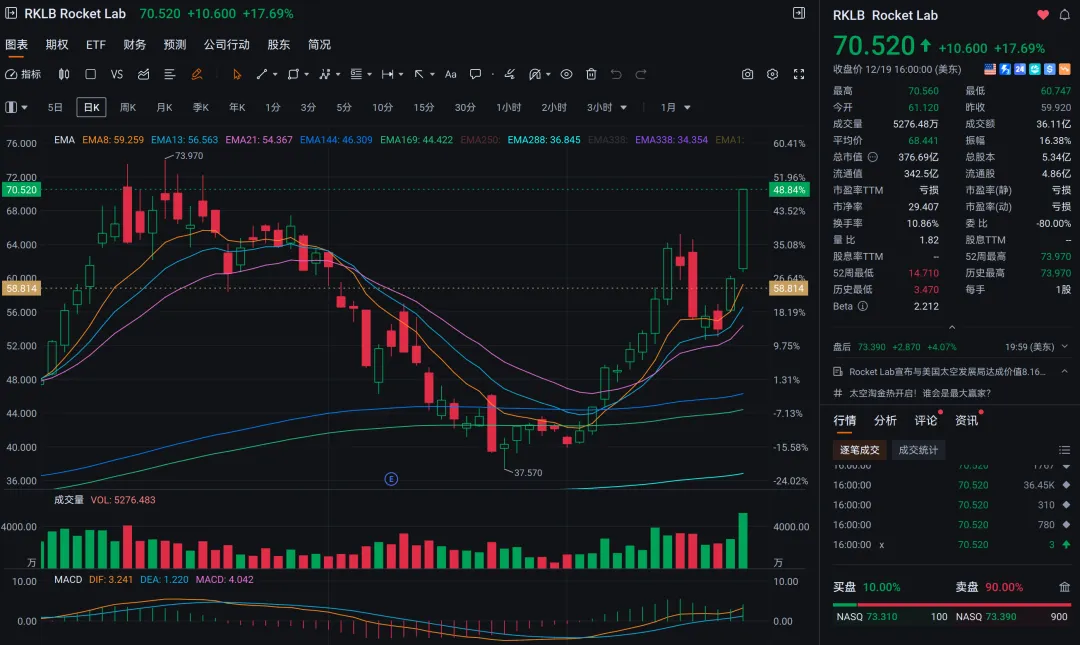
RKLB nearly halved during the broader high-growth stock correction a few months ago, but that gave long-term believers a great entry point. In the final section of Investment in the Space Sector: RKLB Rocket Lab, I wrote my valuation analysis for RKLB:
The creation cycle for this article was quite long. Back then, Rocket Lab's stock was around 30-40. Now it's 67 (as of the latest). Obviously, the current price near all-time highs was something I didn't foresee. Posting this article at a local top is not what I wanted. Given my medium-to-long-term bullish view on Rocket Lab, although now is not the best time to overweight, I hope readers will keep an eye on this company.
Huang Mingtao, WeChat Official Account: Mingtao HUANG Investment in the Space Sector: RKLB Rocket Lab
Those who invested when RKLB corrected to the 30-40 range are now sitting on handsome gains. The 67 level I mentioned as a local top has been proven correct. Good companies need good prices. How does RKLB's valuation logic differ from the previous high? This article offers a simple analysis for new investors; for a detailed breakdown, refer back to the cited article. RKLB's recent strong momentum has not only energized early believers but also forced the financial world to reassess its long-term value. Under the shadow of the SpaceX behemoth, Rocket Lab has carved out an independent and powerful rally—the logic behind it deserves deep analysis.
A Milestone Role Shift: From Launch Provider to Prime Contractor
To understand the catalyst for this rally, look at a watershed contract. The U.S. Space Development Agency awarded Rocket Lab a roughly USD 816 million contract to design, build, and operate 18 satellites with advanced warning and tracking capabilities.
This contract rewrites the company's identity. Previously seen as a rocket launch service provider, Rocket Lab now joins the ranks of Pentagon prime contractors—a status typically reserved for Lockheed Martin or Northrop Grumman. With this award, the company's backlog surged past USD 1.5 billion, offering high visibility and certainty for future revenue growth.
Execution at Its Finest: Rare Early Delivery in Aerospace
In aerospace—a capital-intensive industry notorious for technical risk and delays—execution is the most valuable asset. Just before the mega-contract announcement, Rocket Lab completed a mission for the U.S. Space Force a full five months ahead of schedule. This "reverse delay" in an industry where delays are the norm significantly boosted market confidence in its management and supply chain control. While traditional aerospace giants struggle with parts shortages or technical failures, this reliability premium has made RKLB a safe haven in an uncertain macro environment.
Valuation Ceiling Lifted: The SpaceX USD 800 Billion Spillover
A key driver of this rally is the anchor role of industry leader SpaceX. With SpaceX's latest private market valuation hitting a historic USD 800 billion, secondary market investors face an unprecedented psychological game. Unable to directly capture SpaceX's growth through conventional channels, the market desperately seeks the closest substitute in business model and technology. Compared to the USD 800 billion industry ceiling, Rocket Lab's current market cap of ~USD 37 billion looks highly attractive. This spillover effect from valuation arbitrage has prompted significant institutional rotation into RKLB, seeking multi-fold returns in this still-growing potential giant.
Vertical Integration Moat: Beyond a Single Launch Model
Deeper momentum comes from Rocket Lab's forward-looking business transformation. Management recognized years ago that pure launch services are essentially space logistics, with margins destined to compress as competition intensifies. Through a series of targeted acquisitions and in-house R&D, the company has deeply cultivated its space systems business. Today, Rocket Lab not only offers rocket rides but also manufactures satellite solar panels, attitude control flywheels, and complete satellite platforms. According to the latest financial data, these high-value space systems now contribute over 70% of revenue. This vertical integration allows the company to handle complex contracts without being constrained by external suppliers' costs and lead times, boosting margins while maintaining competitiveness.
The Neutron Rocket Strategic Play: Targeting the Market Core
Looking ahead, the medium-lift Neutron rocket under development is the key weapon for a higher valuation. If Electron is a light truck for small satellites, Neutron is a heavy truck targeting the medium-to-large satellite constellation market. Its unique clamshell fairing design simplifies recovery and reduces refurbishment costs. Recent successful hot-fire tests of its key engine have boosted confidence in a 2026 first flight. Once Neutron enters commercial service, Rocket Lab will be able to handle large-scale constellation deployment, breaking the current near-monopoly in that segment and transitioning from a niche leader to a full-spectrum space powerhouse.
Macro Environment and Strategic Backup: New Opportunities in Geopolitics
Beyond technology and finance, the current macro-political environment provides additional tailwinds. As global geopolitical tensions intensify in 2025, governments' demand for autonomous and diversified space supply chains has peaked. While a dominant player exists, policymakers—from both national security and competition perspectives—do not want a monopoly in core launch services. This search for a reliable strategic backup gives Rocket Lab unique soil to thrive. It enjoys an edge in winning government contracts beyond pure technical metrics, simply because its existence embodies industry competitiveness.
Conclusion: Finding a Certain Future in the Vast Cosmos
In summary, Rocket Lab's doubling in a month is essentially the market's strong endorsement of its certainty. Against the backdrop of SpaceX's USD 800 billion valuation, the company is undergoing an epic transformation from a specialized lab to a full-chain giant. While aerospace inherently carries unpredictable technical risks, Rocket Lab has proven through steady execution that it is the most viable competitor in the trillion-dollar space economy blue ocean. As the Neutron rocket's first flight approaches, this rocket—already ignited in the secondary market—may have just begun its main propulsion toward higher interstellar targets.
Risk Disclaimer: The views in this article are for reference only and do not represent any investment advice. Markets are risky; invest with caution.


专注投资分析、市场洞察与资产配置。不追短期波动,只理解真正驱动长期回报的东西。