Entering April 2026, the global economy faces its most severe test in modern history as the Middle East conflict escalates. Previously scattered fronts have now converged into a full-blown crisis at two critical maritime chokepoints: the Strait of Hormuz and Bab el-Mandeb.
The Strait of Hormuz, the sole outlet for Persian Gulf oil and gas, is on the brink of a physical blockade. Meanwhile, traffic through Bab el-Mandeb, the southern gateway to the Suez Canal, has fallen below 35% of normal levels due to the Red Sea conflict. This means roughly one-third (32%) of global physical trade value (about USD 12 trillion) faces disruption or significantly higher costs.
This report quantifies the flow of goods through these two chokepoints, the degree of disruption, and the extreme global impact when considered as a "double blockade."
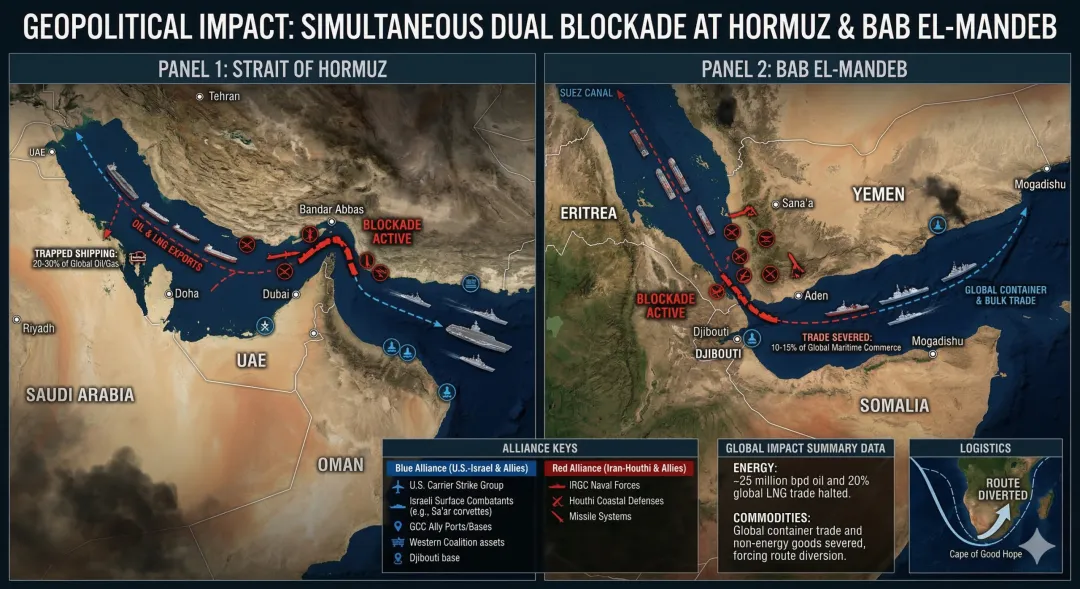
This complex strategic chart provides an anatomical comparison of the blockade status at Hormuz and Mandeb, quantifying key material flows and disruption ratios, along with combined global impact data.
1. Latest Events as of April 2026
The two global chokepoints are at the forefront of the US-Israel-Iran war.
-
Strait of Hormuz: Physical Blockade. As of April 3, the Strait of Hormuz is effectively paralyzed. Except for a few Iran-linked vessels, all commercial shipping has been unable to pass. The area has become a full war zone due to ongoing US-Iran naval clashes. The US has issued an ultimatum to reopen the waterway by April 6, or face a full-scale strike on Iranian energy facilities.
-
Bab el-Mandeb: Trade Fracture. Traffic through Bab el-Mandeb has fallen below 35% of 2023 levels. Although no direct naval battles are occurring in the Red Sea, sustained Houthi attacks on merchant vessels and limited US-led coalition defenses have led most global shipping lines (e.g., Maersk, COSCO) to officially suspend transit indefinitely. The vast majority of East-West trade is now forced to reroute around the Cape of Good Hope.
-
Economic Feedback: Inflation & Shortages. Global oil prices have breached $100/barrel, and LNG prices have hit all-time highs. E-commerce platforms like Amazon have imposed "fuel surcharges" on third-party sellers, reflecting the rapid pass-through of energy shortages to consumers.
2. Strait of Hormuz – The Energy Pulse
This is the world's most important energy artery and the hardest-hit region.
| Category | Key Commodities | Flow / Destination | Core Country Import Share |
|---|---|---|---|
| Energy | Crude oil, LNG | East Asia (80%+) | India (90%), Japan (87%), South Korea (81%), China (~50%). |
| Fertilizer | Urea, ammonia, sulfur | Global agricultural powers (Brazil, India, China) | ~30% of global fertilizer trade passes through here. |
| Industrial | Aluminum, helium, petrochemicals | Global manufacturing hubs | 33% of global helium (used for semiconductor cooling) is produced here. |
3. Bab el-Mandeb – The Supply Chain Nerve
It is the "lifeline" connecting Asia-Europe trade, primarily affecting global consumer goods and manufacturing supply chains.
| Category | Key Commodities | Flow / Destination | Core Impact |
|---|---|---|---|
| Consumer Goods | Electronics, auto parts, textiles | Europe ↔ Asia | ~15% of European imports pass through here. |
| Food | Wheat, corn, feed additives | North Africa, South Asia, Europe | ~8%-10% of global food exports are disrupted. |
| Semiconductors | Advanced chips and packaging | Global tech supply chains | Rerouting adds 2-4 weeks to global electronics delivery times. |
4. Combined Global Impact Analysis
Treating both waterways as simultaneously blocked creates an unprecedented "double choke" scenario in global economic history:
-
Energy Sovereignty: Together, these two routes carry roughly 25%-30% of global seaborne crude oil and about 25% of global LNG trade.
-
Trade Value: Hormuz accounts for 20% of global seaborne trade value, Mandeb for 12%. Combined, 32% (roughly one-third) of global physical trade value faces direct disruption or significantly higher costs.
-
Survival Basics: Critical data shows that about 48% of the global population relies on food grown with synthetic nitrogen fertilizers, and 30%-50% of the supply chain for these fertilizer inputs (urea, ammonia) passes directly through the Strait of Hormuz. This means it is not just an energy crisis but could evolve into a global food security crisis.

专注投资分析、市场洞察与资产配置。不追短期波动,只理解真正驱动长期回报的东西。