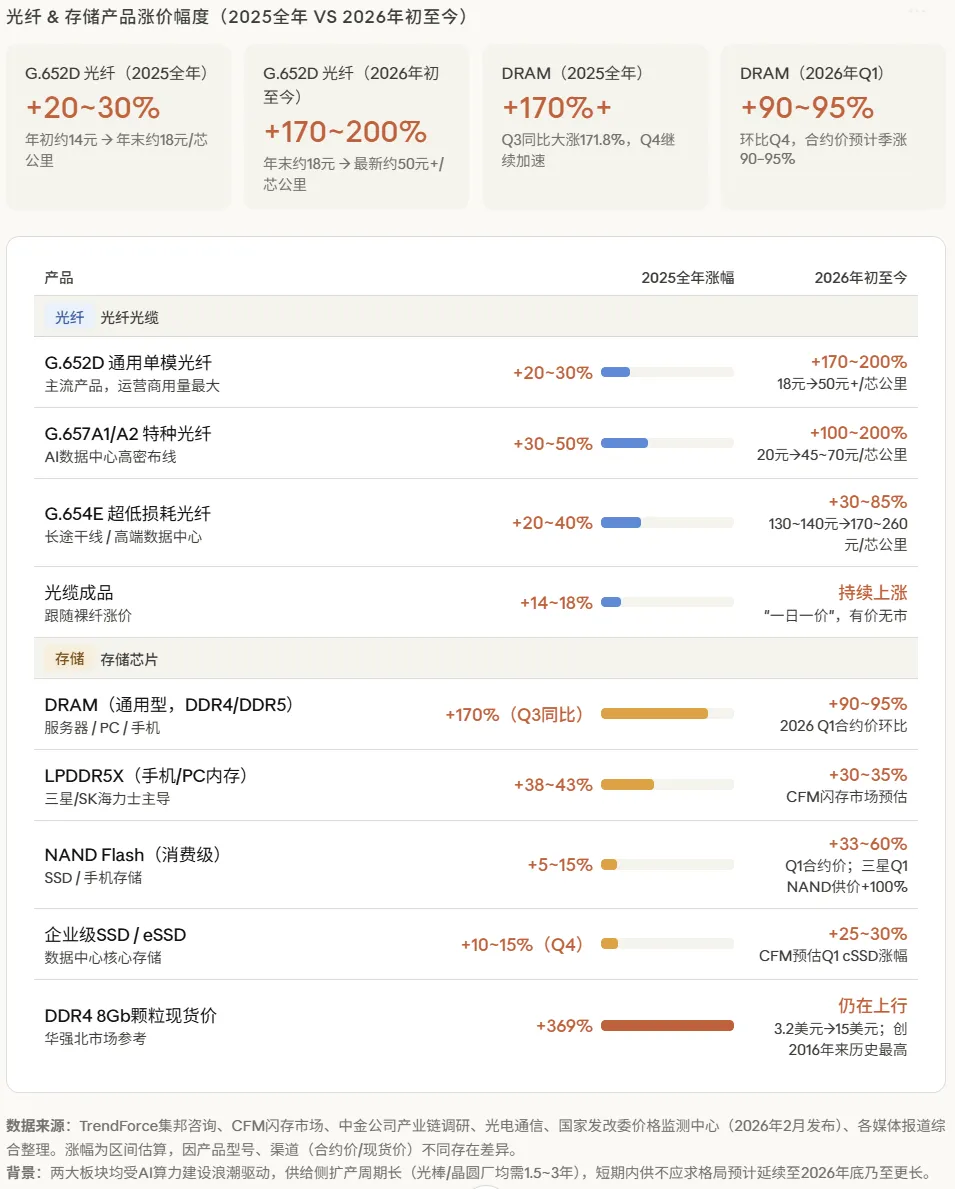
Here, "light" refers to both fiber optics and the memory sector represented by Micron. A growing consensus sees the supply-demand mismatches in fiber optics and semiconductor memory not as traditional cyclical swings but as asset repricing driven by AI's underlying physical architecture demands. The core bottleneck in fiber has shifted to the capital-intensive preform stage, while memory has achieved a fundamental transfer of pricing power through 's cannibalization of general DRAM capacity. In the evolution of AI compute clusters, 2025–2026 will be defined as the year of physical-layer resource repricing. As compute demand breaks through single-machine bottlenecks, the value logic of infrastructure shifts from general-purpose to intelligent computing—not just expanding demand but fundamentally migrating pricing power from buyers (hyperscalers) to sellers (bottleneck asset holders). This report focuses on fiber preforms and HBM, analyzing their marginal game logic in a super-seller market.
1. Core Thesis—Why This Is Structural, Not Cyclical
Both industries share the same anatomy of power transfer: demand is permanently repriced by AI infrastructure, while supply faces structural, multi-year expansion constraints. The result is not a temporary shortage—but a fundamental redistribution of pricing power from buyers to sellers, likely persisting through 2027–2028.
A classic seller market requires three conditions: (1) demand cannot be deferred, (2) supply cannot respond quickly, and (3) suppliers are concentrated and disciplined on pricing. Both industries currently satisfy all three.
The current environment meets the three core elements of a seller market: First, demand non-deferrability. The AI cluster race is fundamentally a game of time—for hyperscalers, missing interconnect bandwidth or memory throughput means expensive compute sits idle, making infrastructure procurement highly price-insensitive. Second, supply response lag. Fiber preform expansion cycles typically take 18–24 months, while advanced DRAM node yield ramps face even more complex process challenges. Third, supplier concentration and pricing discipline. Major players have shifted from pure share competition to profit orientation, shortening contract cycles and adopting post-delivery dynamic pricing to fully pass inflation and supply risk downstream.

专注投资分析、市场洞察与资产配置。不追短期波动,只理解真正驱动长期回报的东西。